

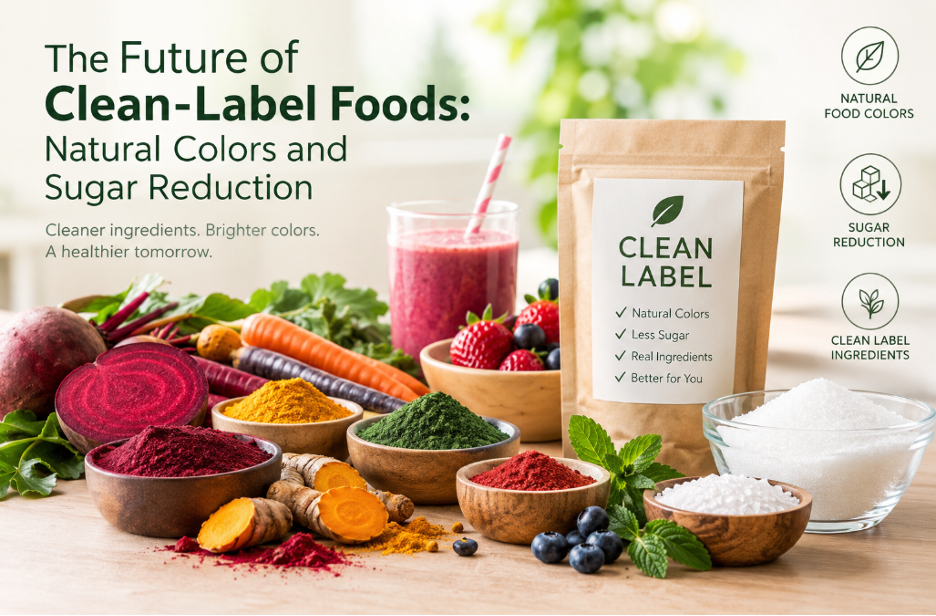
Walk down any grocery aisle and read the back of a few packages. Ten years ago you would have found Red 40, Yellow 5 and a long run of sweeteners nobody could pronounce. Today more labels read like a short pantry list: beet juice, turmeric, monk fruit. Shoppers noticed, and so did product developers.
For food manufacturers, the move toward clean label food ingredients is no longer a trend to watch from a distance. It’s a reformulation project already sitting on someone’s desk. Two items land at the top of that list almost every time: replacing synthetic dyes with natural food colors, and cutting sugar without wrecking the product. This post looks at where both are heading and what they ask of the people making the food.
What clean label means in practice
There’s no legal definition of clean label, which is part of the headache. In practice it comes down to a simple test: could a shopper read the ingredient list and recognize everything on it? Fewer ingredients, familiar names, no artificial colors, flavors or preservatives. Some brands go further and drop anything that sounds like a lab product, even when it’s perfectly safe.
That fuzziness matters because every company ends up drawing its own line. A bakery might be fine with modified starch while a beverage brand won’t touch it. Before you start reformulating, decide what clean label means for your brand and write it down. It saves arguments later and gives your suppliers a clear target.
The pressure comes from several directions at once. Consumers read labels more closely than they used to. Retailers publish their own lists of ingredients they won’t accept. Regulators in many markets have been tightening their stance on synthetic dyes and added sugars. Companies that wait for a rule to force the change usually end up with the least time to do it well.
Natural colors have moved from option to expectation
Color is the first thing a shopper judges. A strawberry yogurt that looks grey doesn’t taste like strawberry, whatever the flavor system says. That’s why synthetic dyes lasted so long. They were cheap, bright and forgiving.
Natural food colors are none of those things by default. They come from sources like paprika, turmeric, beetroot, black carrot, spirulina and annatto, and each one has quirks. Beet red fades with heat. Spirulina blue gets unstable in acid. Carotenoid yellows and oranges can drift in light. None of this is a dealbreaker, but it does mean you can’t swap a natural color in at the same dose and expect the same result.
The practical approach is to treat color as part of the formulation instead of a finishing touch. Test it early, in the real product, under real conditions. Check pH, processing temperature, light exposure and shelf life. A color that looks great on the bench on day one can look tired by week twelve in a clear pack under store lighting.
Suppliers have also gotten better. Extraction and stabilization methods have improved, and there are more options for tricky shades like blue and bright red, which used to be the hardest to replace. Expect that range to keep growing.
Sugar reduction is harder than it looks
Taking sugar out of a recipe removes more than sweetness. Sugar adds bulk, texture, browning, moisture retention and, in some products, preservation. Pull it out and you can end up with something thin, dry or oddly short on flavor.
Manufacturers usually work with a combination rather than a single fix:
- High-intensity sweeteners such as stevia leaf extract and monk fruit, which deliver sweetness at tiny doses.
- Bulking ingredients like soluble fibers, which replace the physical volume sugar leaves behind.
- Rare sugars such as allulose, which behave a lot like sugar in baking and browning.
- Flavor modulators that mask bitterness or a lingering aftertaste.
No single option does everything. Stevia can taste bitter at higher levels. Sugar alcohols can cause digestive discomfort in large amounts. Allulose costs more and is treated differently from one market to the next. The best reformulations tend to blend two or three sweeteners so each one covers the weak spots of the others.
The size of the cut matters too. A 30 percent reduction is a very different job from a 60 percent one. Reducing sugar gradually across a product line often works better than a dramatic overnight change, because palates adjust. Many people who drink a lightly sweetened beverage for a few months find the old version cloying.
Why colors and sweeteners belong in the same project
It might seem odd to cover them together, but they tend to show up in the same briefs. Take a fruit-flavored drink. Cut the sugar and the product can look and taste thinner. Swap the synthetic dye and the shade shifts. Both changes affect how the consumer judges the drink, and both interact with pH, heat and shelf life. Changing one in isolation often forces a second round of work on the other.
Reformulating both at once is usually more efficient. You run one set of stability tests, one round of sensory panels and one shelf-life trial, instead of three.
Questions to ask your ingredient supplier
- Is this ingredient stable at my product’s pH and processing temperature?
- What usage levels do you recommend, and what happens outside that range?
- Can you send samples for trials in my actual formulation?
- How does the ingredient need to be labeled in the markets where I sell?
- What are the realities on supply, lot-to-lot consistency and lead time?
Good suppliers answer these straight, including the awkward ones. Be wary of anyone who promises a drop-in replacement without asking about your product first.
Where this is heading
Expect shorter labels and more transparency about where ingredients come from. Natural colors will keep widening their palette, and sweetener blends will get smarter. The brands that do well will be the ones that treated clean label as a design brief from the start instead of a compliance chore.