

Ask a formulator which part of a natural color switch kept them up at night and acid comes up a lot. A lemon-lime soda, a tangy sauce, a fruit gummy, a drinking yogurt: all sit well below neutral pH, and plenty of natural pigments simply don’t survive there. You can end up with a color that looks perfect in the lab at pH 6 and turns dull, cloudy or the wrong shade once the acid goes in.
This guide covers why low pH is so tough on color, which natural food colors for acidic foods tend to cope, and how to test before you commit to a launch.
Why acidity changes color
Many natural pigments are chemically sensitive molecules. Their structure shifts with the acidity around them, and a change in structure means a change in color. Some pigments are happy in acid. Others fade, precipitate or flip to a different hue.
In practice, low pH usually means below about 4.5. Many soft drinks land between 2.5 and 3.5, and fruit preparations, salad dressings and sports drinks sit in a similar zone. That’s a demanding environment, which is why pH stability of food colors should be the first row on any color selection sheet.
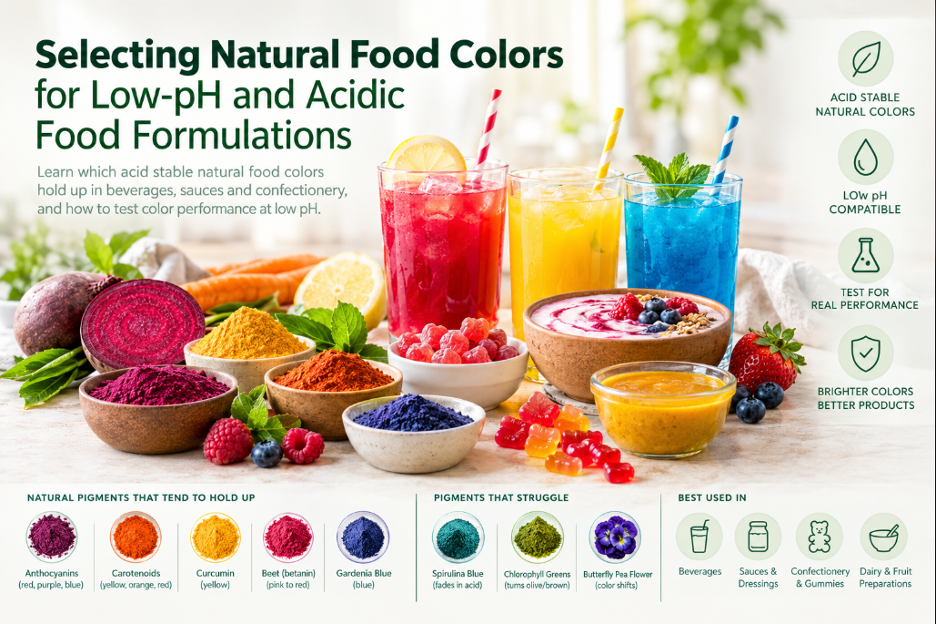
Pigments that tend to hold up
Anthocyanins. These are the reds, purples and blues from sources like black carrot, purple sweet potato, red radish and grape skin. In strongly acidic conditions they sit in their red form, which is exactly why they’re the usual choice for cherry, strawberry and raspberry shades in acidic drinks and confectionery. As pH rises they drift toward purple and blue and eventually lose intensity, so they suit acidic foods better than neutral ones.
Carotenoids. Paprika extract, annatto, beta-carotene and lycopene cover the yellow, orange and red range, and they’re largely unaffected by pH. That’s a big plus. The catch is that they’re fat-soluble, so water-based products need an emulsified or water-dispersible format. They’re also sensitive to light and oxygen over time.
Curcumin from turmeric. It gives a bright yellow in acid. Like carotenoids, it needs a water-dispersible form for beverages, and it doesn’t love light, so clear bottles can be a problem.
Beet (betanin). Beet delivers a strong pink to red and is usually most stable somewhere around pH 4 to 5. It gets weaker as acidity increases and is sensitive to heat, so it works better in cold-fill or short-process products.
Gardenia-derived blue. Often discussed as a better option than spirulina for lower-pH applications. Availability and labeling rules vary by market, so check with your supplier before you build a recipe around it.
Pigments that struggle
Spirulina blue. Very popular, but the pigment is protein-based. Below roughly pH 4 it tends to fade or fall out of solution, and heat makes it worse. If you want blue in a carbonated drink, it isn’t a simple swap.
Chlorophyll greens. Acid converts chlorophyll into a compound that looks olive or brownish. Bright greens in acidic foods usually come from blending a yellow with a blue instead.
Butterfly pea flower. The color moves dramatically with pH, from blue at neutral through purple to pink as acidity rises. Great for color-change drinks, awkward if you want a steady blue.
Matching color to product
- Clear acidic beverages. Clarity matters, so you need water-soluble or fully dispersible colors. Anthocyanins work for reds. Water-dispersible carotenoids or curcumin handle yellows and oranges, with attention to light exposure.
- Gummies and confectionery. Cooking heat and late-added acid both stress the color. Add acid and color as late in the process as you can, and test the shade after the product has set.
- Sauces, dressings and pickled products. Oil and water phases, plus long shelf life. Paprika and other carotenoids do well, but watch for oxidation over time.
- Dairy and fruit preparations. Fruit brings acid, pasteurization brings heat. Anthocyanins and carotenoids are common choices, and it’s worth checking how the color interacts with proteins.
Other things that affect color
pH is only one variable. Heat during processing, light in the store, oxygen trapped in the pack, and trace metal ions can all move a shade. Ascorbic acid, often added as an antioxidant, can speed up the loss of anthocyanin color in some systems. Flavor oils and sweeteners can change how a color behaves too. Natural food color formulation is rarely about one factor, and that’s why small recipe changes sometimes cause surprising shade shifts.
A practical testing routine
- Measure the real pH of your finished product, not the target on the spec sheet.
- Dose the color at three levels so you can see how the shade responds.
- Run accelerated shelf-life tests with warm storage and light exposure, in the actual packaging.
- Check at fixed intervals for hue, intensity, haze and sediment.
- Use a colorimeter alongside your eyes. Lab values catch drift that people miss.
- Re-test after any recipe change, even a small acid adjustment.
Common mistakes
- Testing in plain water or a base instead of the full formula.
- Judging the color on day one and never revisiting it.
- Ignoring packaging, especially clear bottles and pouches.
- Adding acid before color in the process when the order could be reversed.
- Assuming one supplier’s grade behaves like another’s.
Working with your supplier
Acid performance varies a lot between grades, even when two products come from the same raw material. Extraction method, concentration and added stabilizers all play a part. Give your supplier the numbers: finished-product pH, process temperature, fill method, packaging type and target shelf life. The more specific you are, the more useful their recommendation will be, and the fewer rounds of sample trials you’ll need. Ask for stability data at your pH, not just the general technical sheet.
The short version
Acidic products can absolutely carry natural color, but the pigment has to be chosen for the job. Start with the pH, pick colors known to tolerate it, and test under real conditions before you scale. A little patience in the lab saves a lot of regret on the shelf.