

Clean Label Food Products: What Consumers Really Want Today
There’s no doubt that the world of food and beverage has transformed itself significantly in the last decade. Today’s consumer is increasingly looking beyond flavor or cost; we’re paying far more attention to the ingredient statements on packaging, the nutritional data found there, and where and how the food was sourced.
Consumers are actively seeking out brands that offer recognizable ingredients and are actively trying to eat and live healthily, which means clean-label food products are no longer just a niche concept but are currently a driving food and beverage innovation trend. From savory snacks and bubbly beverages to confections and baked goods, brands have jumped at the opportunity to reformulate their products to satisfy consumers while still preserving their tastes and visual appeal.
What Are Clean Label Food Products?
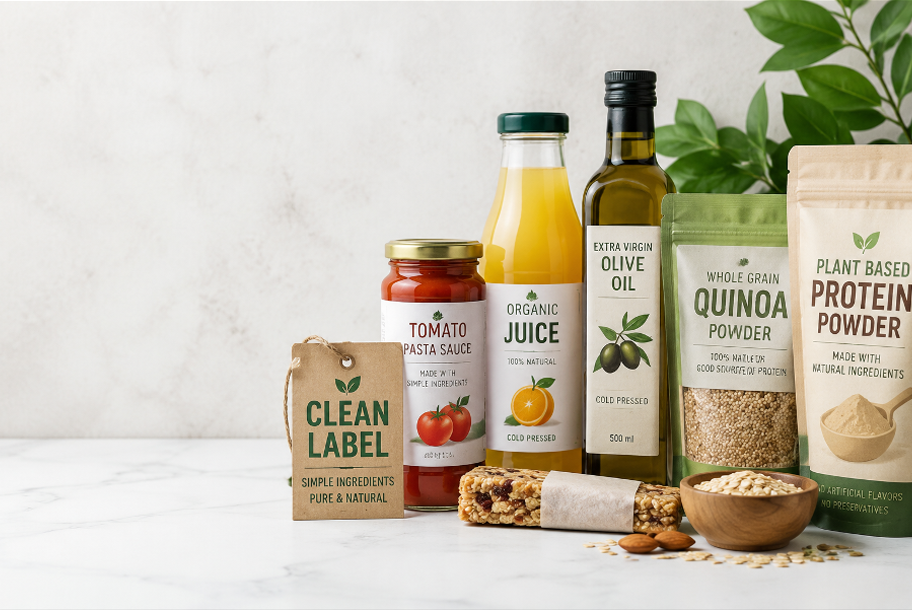
Clean Label Food products are basically simple ingredients. Foods and beverages with ingredients that you can pronounce or understand. You will notice that there is no official “clean label definition.” What people think when they mention “clean label” foods is that it entails the following:
- Natural ingredients
- Minimal processing
- No artificial colors or flavors
- No unnecessary preservatives
- Transparent ingredient labeling
- Ingredients sourced responsibly whenever possible
Why Consumers Are Choosing Clean Labels
It’s clear that today’s consumers are doing more of their own ingredient research. Access to information on the web has empowered buyers, and now, consumers tend to see natural ingredients as synonymous with quality, wellness, and security. These factors are helping to fuel an increase in products that boast the following:
- A rise in overall health consciousness
- A need for ingredients transparency
- An interest in sustainable sourcing practices
- A preference for familiar ingredients
- An increase in a natural food-centric approach
The Rise of Natural Colors and Sweeteners
As it stands, artificial colors and sweeteners are one of the leading areas of concern for a majority of health-conscious consumers.
This is causing food and beverage producers to seek natural, plant-based alternative ingredients that perform as well as their synthetic counterparts but inspire consumer confidence.
By turning to a range of sources, including fruits, vegetables, spices, algae, and botanicals, and utilizing them to extract naturally sourced colours, manufacturers can make products with bright appeal while supporting the growing clean label movement. In addition, natural sweeteners, such as stevia, Monk fruit, and allulose, can provide brands with sweet options while reducing overall sugar intake.
Understanding Clean Label Ingredient Trends
Modern clean label ingredients trends show that transparency is just the beginning of consumers’ demand. They desire food and beverage products formulated with natural ingredients but delivering desirable taste, visual cues, and functionality.
Below are some of today’s leading clean label ingredient trends:
- Replacing synthetic colors with natural food colors
- Utilizing sweetening systems with a plant-based origin
- Utilizing a shorter, less complex list of ingredients
- Including non-GMO ingredients
- Incorporating ingredients from certified sustainable sources
- Producing formulations that are vegan and vegetarian-friendly
- Offering products that are organic-compatible
Why Manufacturers Need Natural Ingredient Solutions
When formulating for clean label success, simply removing artificial ingredients isn’t the end of the story.
Each replacement ingredient must provide equivalent color stability, flavor, texture, shelf-life, and processing functionality. Reliable natural ingredient solutions are key.
Food formulators require ingredient solutions that deliver consistent performance for a range of applications, such as:
- Beverages
- Bakery products
- Confectionery
- Dairy products
- Frozen desserts
- Snacks
- Nutritional products
- Plant-based foods
Natural ingredients Solutions give producers vibrant colours and balance in sweetness, stability, and the taste of what consumers expect from clean-label products.
Challenges of Clean Label Development
Although there is a vast range of opportunities in the space, the clean label transformation can pose several technical hurdles for formulators to navigate.
Manufacturers commonly need to address:
- Color stability in processing
- Heat resistance
- Light sensitivity
- pH suitability in products
- Shelf life functionality
- How it interacts with flavors
- Other food ingredients Compliance on an international scale
With support from the seasoned ingredients specialists, you gain advantages like less product development time and a smoother route to product specification, while formulation comes up quicker and becomes much more predictable.
The Future of Clean Label Innovation
Consumer preference will keep changing. Food buyers in the near future will likely demand more transparency and a clearer sense of traceability. Manufacturers should look at ways of innovating on ingredients now in order to respond to market needs in the future.
The use of new technologies allows for the innovation of natural colours and natural sweeteners that will deliver functionality comparable or superior to conventional synthetic ingredients.
Conclusion
Consumers’ growing preference for clean label food is part of a larger trend toward transparency, naturalness, and confidence. It’s about developing delicious food with ingredients people can readily identify and feel good about consuming. Accomplishing this requires smart formulation, strong technical capability, and unique ingredient innovation.
By providing sophisticated natural coloring and sweetener innovation, FoodRGB empowers food and beverage companies to meet future consumer demands ahead of the curve. The most adaptable natural ingredients, innovative application expertise, forward-looking product development capabilities, and our commitment to setting the benchmark for ingredients.