

Once a manufacturer settles on a natural color source, a second question arrives quickly: liquid or powder? Both are legitimate choices, and plenty of plants end up using some of each. But the format affects dosing accuracy, line setup, storage, freight costs and sometimes the look of the finished product. This guide compares the two from the factory floor.
What the formats actually are
Liquid colors are extracts or formulated colors carried in water, glycerin, oil or another medium, often with a preservative or stabilizer. Powder colors are dried, either as a purified extract or spray-dried onto a carrier such as maltodextrin. The pigment can be the same in both. The difference is the delivery vehicle, and that vehicle has consequences for handling and labeling.
Liquid colors: where they shine
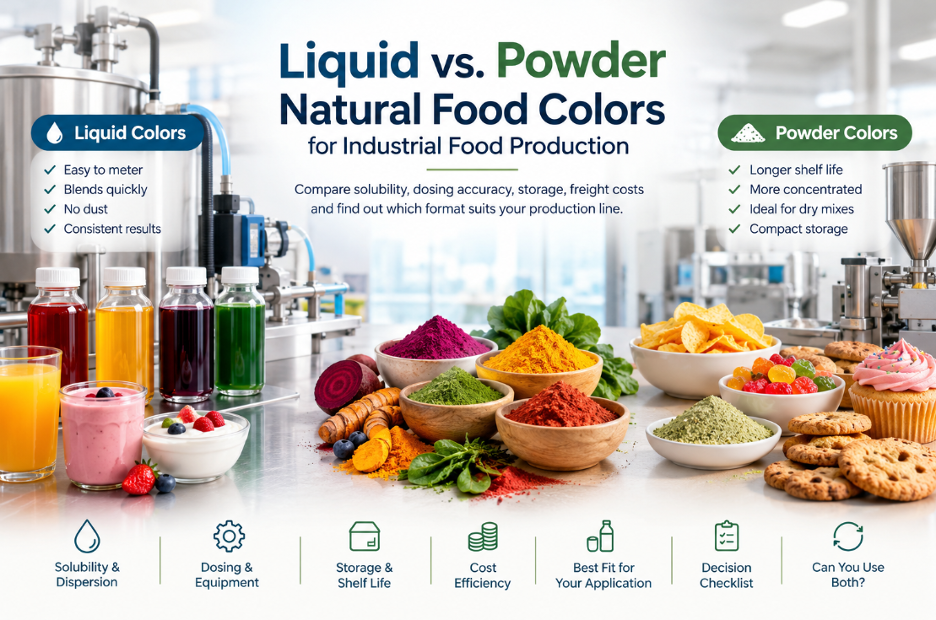
- Easy to meter with pumps, which suits continuous inline production.
- Mix quickly into water-based products such as beverages, syrups and dairy.
- No dust, so operators have less to handle and clean.
- Consistent results when metering is calibrated properly.
The trade-offs are real, though. Liquids are heavier to ship and store per unit of pigment because they carry water or other carriers. Some need cold storage. Once a container is opened, shelf life can shorten, and microbial growth is a risk if handling is sloppy. Liquids can also separate or freeze in the wrong conditions, and the carrier adds a bit of water or oil to your recipe.
Powder colors: where they shine
- Longer shelf life, and many powders store happily at ambient temperature.
- More concentrated per kilo, which usually means lower freight cost for the same coloring power.
- Well suited to dry mixes, seasonings, coatings and baking blends where extra moisture is unwelcome.
- Compact to store.
Powders have their own headaches. Dust is a hygiene and safety concern. Fine particles can clump, leave specks or dissolve slowly if they’re added carelessly. Powders can pick up moisture from the air, so containers need to be resealed properly. The carrier can also affect the label or texture, depending on what it is.
Solubility and dispersion
Natural food color solubility depends on the pigment as much as the format. Anthocyanins and betalains are water-soluble. Carotenoids are oil-soluble and need emulsification to work in water-based products. A powder labeled for water use and a liquid labeled for oil use are not interchangeable, even if the shade looks the same in the bucket.
Good powder color dispersion comes down to technique. Pre-dissolving the powder in a small amount of water, or blending it into a portion of the dry ingredients first, helps avoid specks. High-shear mixing can solve stubborn cases. For liquids, check compatibility between the carrier and your base. An oil-based color dropped into a water-based mix will not behave.
Dosing and equipment
Liquid color dosing systems typically use peristaltic or metering pumps with inline flow meters. Calibrate them regularly, and plan for line flushing to prevent carryover between colors. Viscosity affects pump choice, and temperature can change viscosity from morning to afternoon.
Powders call for loss-in-weight or screw feeders, dust extraction and humidity control. Weighing needs to be precise. With natural colors, even small dosing errors can show up as visible shade differences between batches, so whichever format you pick, accuracy matters more than speed.
Storage, shelf life and logistics
Compare formats using the supplier’s actual specifications: storage temperature, shelf life unopened, shelf life once opened, and sensitivity to light and heat. Liquids tend to take up more space and sometimes need refrigeration. Powders take up less room but need dry, sealed storage. Either way, a first-in, first-out routine and clear opening dates on containers prevent a lot of quality complaints.
Compare cost per unit of color, not per kilo
A liquid can look cheaper per kilo while containing far less pigment than a concentrated powder. The honest comparison is cost in use: what it takes to color a fixed batch size to the target shade. Include freight, storage, waste, labor and cleaning time. When you run the numbers that way, the answer sometimes flips.
Which format suits which application
- Beverages, syrups and dairy. Usually liquid, because it blends fast and meters cleanly.
- Dry beverage mixes, seasonings, baking mixes and coatings. Usually powder, since you can’t afford added moisture.
- Either can work. It depends on whether the process can handle the extra water from a liquid.
- Bakery and extruded snacks. Both are used. Liquids can be sprayed or mixed into batter, while powders go straight into dough or seasoning.
A quick decision checklist
- Is the product water-based or dry?
- Does the line already have metering pumps or powder feeders?
- Can the recipe absorb extra water or carrier?
- How long will the color sit in inventory?
- How much storage and cold space is available?
- How tight is the shade tolerance?
Can you use both?
Many plants do, and it isn’t a compromise. A beverage line might run a liquid for the main product while the seasoning line next door uses a powder of the same pigment. Keeping both formats approved with the same supplier gives you flexibility if a line changes or supply tightens.
The main caution is consistency. Shade can differ slightly between a liquid and a powder version of the same color, because the carrier and processing are not identical. If the same product could be colored either way, run both in trials and set a clear specification for the target shade, so nobody on the floor is guessing.
Final thought
There’s no universal winner. The right format is the one that fits your product, your equipment and your storage reality. Ask your supplier for both formats where possible, run side-by-side trials in your real process, and let the results decide. Plenty of plants end up with both on the shelf, and that’s perfectly fine.