

How to Choose the Right Natural Food Coloring for Different Food Applications
In today’s marketplace, consumers scrutinize food labels like never before. That’s why brands are shifting from artificial colors to natural colorants which offer bright colors, but satisfy the “clean label” demands consumers desire. Choosing the appropriate natural color for food depends not only on your brand’s specific color needs.
The ingredients within a food product have varying process, pH and shelf-life conditions, which will impact color outcome.
Here is your guide to selecting natural color for food based on application, ensuring you maintain consistent quality and visual appeal.
Why Choosing the Right Natural Food Coloring Matters
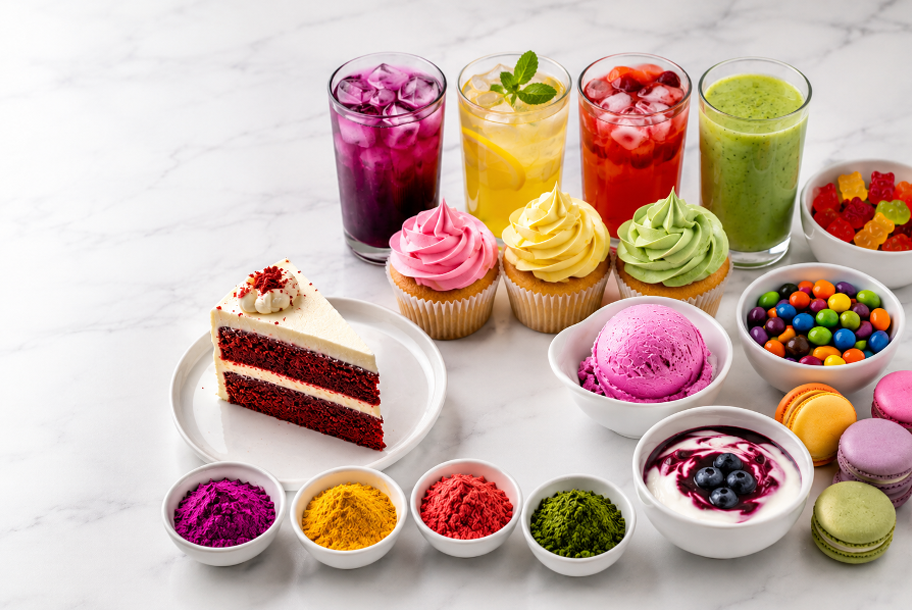
Made from fruits, vegetables, seaweed, spices, minerals and other sources, natural colors are an attractive clean-label option but can react to different food matrices. Selecting the correct natural food colorant can aid your food manufacturer in:
- Keeping color stable during the process.
- Providing attractive, uniform finished products.
- Satisfying consumer need for natural ingredients.
- Increasing shelf life and appeal of products.
- Meeting clean-label claims.
- Start by knowing your product’s destination and use.
Consider the Type of Food Application
Formulation can differ for every category. You cannot have a really effective food application color guide without knowing the finished food.
Beverages
Color is crucial in beverages to maintain the appearance of your drink, but it also needs to be stable over time in liquid and retain its brilliance. Color in beverages needs to be able to withstand effects like light, pH level and pasteurization, and using colors formulated for your beverages can keep this color consistent all the way to the beverage the moment your customers enjoy it.
Confectionery
Gummy, hard candies, and chewy candies are typically manufactured using a high-temperature process. For confectionery, natural colors need to withstand heat and remain bright in both processing and storage.
Dairy Products
Refrigerated products such as ice cream, flavored milk products and yogurt will demand a color that does not fade or stratify under refrigerated conditions. Creamy products also play a part in color manifestation and application driven color selection will be key.
Bakery Products
The baking processes often incorporate elevated temperatures which can damage some natural colorants. Different frostings, fillings, cakes, cookies, and pastries require specific natural coloring solutions based on the processing involved.
Meat and Savory Products
Natural browns, reds and caramel nuances that need to withstand heat in the processing stages as well as shelf-stable colors are often needed for processed meat products, sauce products, seasoning products, savory applications and more.
Evaluate Processing Conditions
One of the most crucial steps when choosing a natural colorant is assessing your own manufacturing process. You may want to consider your:
- Cooking or baking temperatures
- Pasteurisation
- Chilling or freezing
- Dry mixing
- Fermentation
- Extrusion
- pH
- Oxygen exposure
- Exposure to light
A color that is excellent in refrigerated beverages might completely disintegrate at cooking temperatures or in acidic solutions.
Match Color Performance to Product Goals
A brand is identified by its visuals and in turn its brand color needs to be familiar and remain familiar across different product batches. When selecting an all-natural food color, a manufacturer should consider:
- Desired shade intensity
- Transparency or opacity
- Stability of shelf-life
- Compatibility with ingredients
- Consistency between batches
- Market compliance regulations for target markets
Developing toward functionality and design equally is going to yield consumer brands customers come to rely on and be able to identify with.
Think Beyond Appearance
Natural Food Colors build trust. Modern consumers crave clean labels. Customers prefer to see and recognize all ingredients in their food, rather than seeing long, unpronounceable chemical compounds.
Companies that utilize natural colorants have an advantage – you’re already meeting consumer demand while delivering the highest quality product.
This awareness means it is increasingly common to approach natural colors from the initial stages of product development, rather than considering color a “last-touch” additive.
Work with an Experienced Ingredient Partner
Sourcing and choosing natural colors is a science in itself and one that becomes technically demanding when working with new food applications or updating current products. A skilled natural color supplier can help.
- Help you custom develop a color
- Conduct application trials and tests for your specific food product
- Offer recommendations for color stability and use
- Match an existing shade and achieve regulatory compliance
- Provide support throughout your manufacturing processes.
Working together will help ensure the color guide is the perfect fit and prevent expensive rework down the line.
Test Before Full-Scale Production
Tests confirm the reliability of:
- Processing
- Storage
- Packaging
- Packaging aesthetics in consumer’s eyes
- Production variability
Conclusion
The key to a successful choice for a natural color food product extends far beyond achieving your target color. The parameters of the product formulation including processability, shelf life requirements, the type of food or beverage being colored and the consumer demand all weigh in on the optimum color solution. A thoughtfully selected natural food color with a functional food coloring application guide is essential to produce appetizing food products and support your clean label goals.
We at FoodRGB, recognized the uniqueness of each food & beverage application and custom developed natural food color and sweetener solutions to satisfy various production challenges around the world.
If it is beverages, confections, dairy, bakery, savory food & much more, FoodRGB can develop a perfectly suited natural food ingredient product solution that matches your desire for eye-catching results with unparalleled quality, innovative & sustainable approaches.